
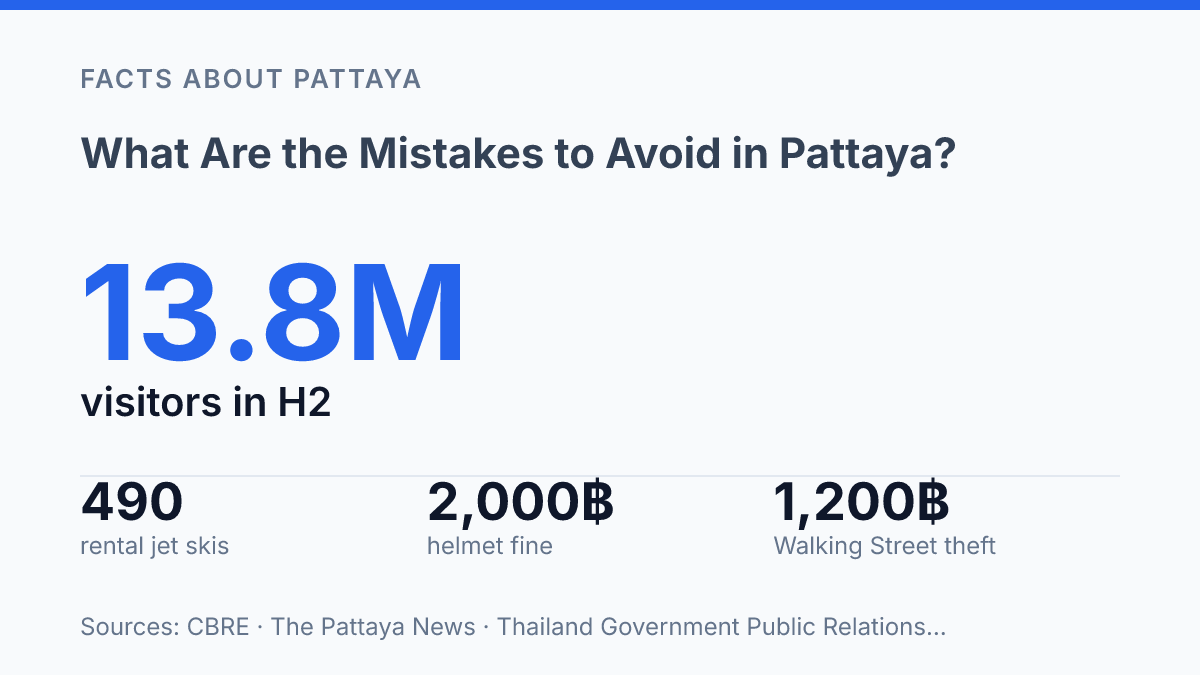
The answer to “What are the mistakes to avoid in Pattaya?” starts with scale: Chonburi recorded 13.8 million visitors in the second half of 2025, so small planning errors can turn into real delays, fines, or losses. Pattaya’s appeal often comes from its easy rhythm, but the practical risks are less relaxed: scooter rules are enforced, nightlife areas attract opportunistic theft, and beach or water-sports disputes can involve official penalties.
A South Pattaya checkpoint on 16 August 2026 recorded 14 no-licence cases and 5 no-helmet cases in one early-morning operation, a useful reminder that informal rental habits do not replace legal requirements. This guide focuses on the errors most likely to affect visitors on the ground, from transport paperwork and traffic exposure to pressure scams, valuables, beach conduct, and choosing operators who follow local rules.
Common travel errors that cause problems
Chonburi still recorded 13.8 million visitors in H2 2025, according to CBRE, which means small planning errors in Pattaya can become expensive quickly when demand is high around beaches, hotels, and transport corridors. Arrival-day decisions are especially prone to overpayment because tired travelers often accept the first ride, the nearest hotel option, or an assumption about entry rules without checking the details that affect cost and legality.
Taxi and songthaew fares should be confirmed before departure, particularly when the ride is not being charged by a meter. A metered taxi gives a fare based on distance and time, which makes the price more transparent, although some drivers may prefer a fixed quote in tourist areas.
Negotiated rides can still be practical, but the total price, destination, currency, and whether the fare covers all passengers should be clear before the vehicle moves. Songthaews add another source of confusion because some operate like shared route vehicles while others are treated like private hires; assuming one price model when the driver is using another is a common cause of disputes.
Visa and entry mistakes create a different type of problem because they cannot always be fixed locally without cost or disruption. Visa-exempt entry is a limited stay granted to eligible passport holders, not an open-ended permission to remain in Thailand.
Longer visits, repeat entries, work-related stays, and trips that may exceed the stamped permission period require advance checking against current Thai immigration rules. The practical risk is not only an overstay penalty, but also disrupted onward travel, denied boarding before departure, or difficulty extending a stay if the original plan was unrealistic.
Accommodation errors often come from choosing a low nightly rate without mapping the return journey. Hotels farther from the beach, main transport routes, or late-night activity zones may look cheaper, but the saving can shrink once repeated taxi or private songthaew rides are included.
Convenience near major tourist areas usually costs more, yet staying too far out can create a second expense in the form of limited transport options after dark. A better assessment compares the room price with walking access, regular transport availability, and the likely cost of returning at night rather than judging the booking on price alone.
Transport and traffic mistakes to avoid
The cheapest ride in Pattaya can become expensive when a 10-baht shared songthaew is mistaken for a private taxi. Shared pickup trucks, often called baht buses, commonly run fixed loops through central areas and charge low per-person fares when passengers board and alight along the route.
The mistake is stopping one as if chartering it, giving a specific destination, or asking the driver to detour without agreeing on the fare first. At that point, the ride may be treated as private hire rather than shared transport, and the price can rise sharply because the vehicle is no longer operating as part of its normal route.
Fare clarity matters most before the vehicle moves. A shared songthaew is usually paid at the end by handing cash to the driver, while a private hire should be priced as a whole journey before departure.
Confusion often comes from the same vehicle serving both purposes, depending on how it is hailed and what the passenger asks it to do. For short local trips, this system can be efficient, but vague communication gives the visitor little control over cost.
Motorbike taxis and scooter rentals create a different kind of risk because the financial exposure is not limited to the fare. Thailand’s Department of Land Transport guidance, published through Thailand.go.th, says foreign tourists need either a 1949 Geneva Convention International Driving Permit or an ASEAN-issued licence; without one, they need a temporary Thai licence.
From 1 June 2025, motorcycle riders and passengers must wear helmets, with violations carrying fines of up to 2,000 baht, according to Thailand’s Government Public Relations Department. Local enforcement is not theoretical: The Pattaya News reported that a South Pattaya checkpoint on 16 August 2026 recorded no-helmet and no-driver’s-licence cases.
Insurance is the practical problem many renters overlook. Travel insurance and rental agreements often exclude claims when the rider lacks the correct licence, is not wearing a helmet, is carrying an unauthorised passenger, or is involved in activity outside the policy wording. That can leave medical bills, vehicle damage, and third-party claims with the rider, even when the rental itself looked inexpensive.
Traffic around Beach Road, Second Road, and central Pattaya can also turn short distances into slow journeys during busy hours. One-way flows, beach crossings, hotel drop-offs, nightlife traffic, and mall-adjacent congestion reduce flexibility, especially when a vehicle has to circle back rather than stop directly outside a destination. The safest planning assumption is that cheap local transport is useful for simple point-to-point movement, while rented scooters and unclear hires carry the highest risk of turning a routine trip into a costly mistake.
Nightlife, scams, and personal safety
A disputed bar bill can escalate fastest when drinks are ordered in rounds but receipts are checked only after everyone is ready to leave. In Pattaya’s entertainment areas, the common avoidable errors are paying before reviewing the itemised total, accepting vague explanations for “extra” drinks, or allowing a group tab to run without knowing who ordered what. Inflated bills, duplicate charges, and drinks appearing on receipts after brief conversations are not features of every venue, but fast service, loud rooms, and mixed cash-card payments make mistakes and opportunistic overcharging harder to challenge calmly.
Most nightlife venues operate as legitimate businesses, yet the conditions around Walking Street and nearby late-night strips increase exposure to theft and poor decisions. Market figures from CBRE put Chonburi arrivals at 13.8 million in H2 2025, even after a 0.6% year-on-year decline, with Thai visitors making up 64% of total arrivals. That volume matters because crowded pavements, busy bars, and late transport queues reduce personal space and make unattended phones, wallets, bags, and document pouches easier targets.
Alcohol is often the factor that turns a minor inconvenience into a costly safety problem. A visitor who carries a passport, several bank cards, and all available cash after midnight has little margin for error if a bag is misplaced or taken. Khaosod English reported a Pattaya Walking Street theft case in December 2025 involving an Israeli tourist who lost 1,200 baht, US$300, and 160 Israeli shekels; the value was modest by travel-insurance standards, but the practical disruption from lost money and documents can be much larger.
Safer practice is usually procedural rather than dramatic: keep the passport locked in accommodation unless it is genuinely needed, carry only the cash and card required for the evening, photograph receipts before disputing them, and settle bills while still clear enough to check line items. After late-night visits, unlicensed or unsolicited rides should be avoided, especially when the driver approaches outside a venue and refuses a clear fare or destination. The same caution applies to street approaches that begin as entertainment, fortune-telling, or friendly assistance but become pressure to pay a higher amount than first stated.
Respect for local rules and beach etiquette
A beach chair dispute or uncovered shoulders at a temple may look like a small lapse, but Pattaya also sits within a legal system where some breaches carry far heavier consequences than a warning. Religious sites near the city, including Wat Phra Yai, generally expect modest clothing and restrained conduct.
Shoulders and knees should be covered, shoes should be removed where signs or local practice require it, and photos should not interrupt worshippers or ceremonies. The same standard applies around Buddha images, where climbing on structures, posing disrespectfully, or treating sacred spaces as photo props can offend even when no formal penalty follows.
Beach conduct is governed as much by shared space as by written rules. Littering is one of the clearest mistakes because it damages the public beachfront and can attract enforcement in managed tourist areas.
Smoking should be avoided wherever restriction signs are posted, especially on beach zones where local authorities display no-smoking notices. Rented loungers and umbrellas should be treated as paid spaces rather than open seating; using them without agreement can create unnecessary disputes with vendors, while spreading towels or belongings in a way that blocks walkways reduces already limited public space.
Local enforcement around the beach is not limited to visitors. Pattaya Mail reported that one Pattaya Beach chair vendor was suspended for 15 days, from 1–15 August 2025, after complaints about illegally reserving public parking and intimidating people who did not rent chairs.
The point for travellers is not that every vendor interaction is risky, but that beach management involves rules for both businesses and the public. Choosing clearly available seating, asking the price before using rented equipment, and moving away from pressure tactics helps avoid becoming part of a dispute.
Drug offences require a different level of caution. Thailand treats many narcotics violations as serious criminal matters, and possession or use of controlled substances can lead to arrest, prosecution, imprisonment, fines, and immigration consequences.
Public-information guidance cannot replace legal advice, but the practical rule is straightforward: assuming that tourist areas are tolerant of drug use is a serious mistake. Etiquette errors may cause embarrassment or local offence; drug-law breaches can change the course of a trip and create consequences long after leaving the beach.
Why small checks matter more in a high-volume resort city
A safer Pattaya trip is less about suspicion than verification. The city rewards visitors who check licences before riding, agree prices before accepting services, keep valuables controlled in nightlife areas, and treat beach rules as enforceable public order rather than local custom. That approach also helps separate ordinary tourism friction from situations that carry legal or financial risk.
As visitor numbers remain high, enforcement is likely to stay visible around scooters, marine rentals, nightlife zones, and beachfront businesses. The practical consequence is clear: in Pattaya, the costliest mistake is often not bad luck, but assuming that a casual setting means casual rules.
Frequently Asked Questions
Q: What common mistakes should first-time visitors avoid in Pattaya?
A: Overplanning and ignoring local conditions are common errors. Pattaya is spread across distinct areas, so transport time and traffic can affect how much can realistically be seen in a day. A practical approach is to plan for a smaller number of activities and leave room for delays.
Q: Is it safe to book tours or activities on the street in Pattaya?
A: Street booking can be convenient, but checking the operator’s reputation first is safer. Reviews, clear pricing, and written confirmation help reduce the risk of misunderstandings about what is included. This matters most for higher-cost activities where refund terms may be less flexible.
Q: What transportation mistakes do travelers make in Pattaya?
A: A common mistake is assuming short distances are always quick to cover. Traffic patterns, one-way routes, and limited pedestrian infrastructure can make journeys slower than expected. Comparing ride options before setting out can save both time and money.
Q: How can visitors avoid scams or overpaying in Pattaya?
A: Unclear pricing is the main risk in tourist-heavy areas. Confirming the total price before agreeing to a service, keeping change handy, and avoiding unlicensed offers reduce the chance of disputes. Written receipts or booking records provide a useful reference if problems arise later.
Q: What behavior should be avoided to respect local customs in Pattaya?
A: Public conduct matters, especially in places of worship and other formal settings. Dressing appropriately, speaking calmly, and showing respect to staff and local residents helps prevent misunderstandings. Basic courtesy is often enough to avoid unnecessary conflict.