
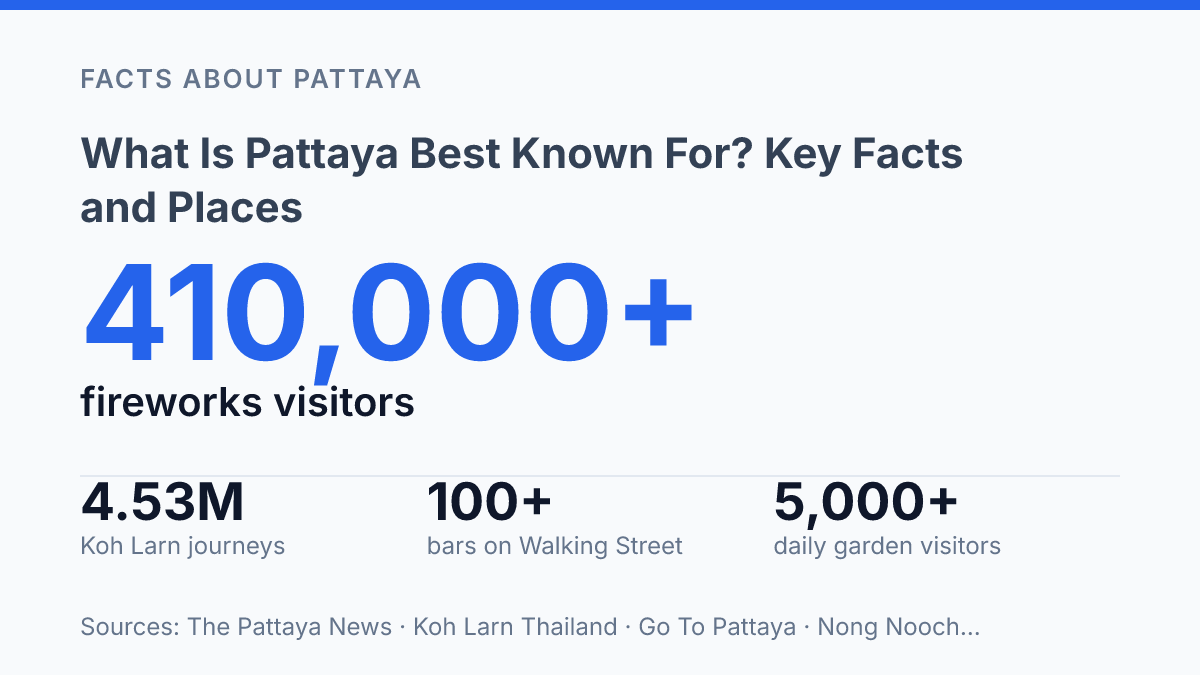
The answer to “What is Pattaya best known for?” starts with nightlife, but Chon Buri’s 28,156,302 visitors in 2024 show a resort economy too large to be explained by one street. Pattaya’s global image still rests heavily on Walking Street, a 700-metre entertainment strip active deep into the night, yet the same city draws ferry traffic to Koh Larn, fills hotels during bayfront events, and supports major family attractions such as Nong Nooch Garden and Ramayana Water Park. This mix helps explain why visitor receipts reached 316,811.02 million baht in 2024, according to Thailand’s National Statistical Office.
Pattaya is best understood as a layered coastal destination: beach town, nightlife centre, event host, island gateway, and short-break city for both Thai and international travellers. The details behind that reputation reveal a more varied place than the shorthand suggests.
Beaches, bay views, and nearby island trips
Pattaya’s strongest coastal advantage is not pristine seclusion but the ability to move from a central city beach to an offshore island within the same half-day. That convenience explains why the shoreline remains central to the city’s image even when beach conditions vary by season, tide, and visitor volume. The best-known coastal areas are Pattaya Beach, Jomtien Beach, and Wong Amat Beach, each serving a different version of the city’s seaside appeal.
Pattaya Beach is the most central and visibly urban of the three, running along the bay beside hotels, malls, restaurants, and the main beachfront road. Its appeal is access: visitors can stay near the water without leaving the commercial core, and the broad bay gives the city its most recognisable sea views. Pattaya Mail reported that the Pattaya Beachfront Landscape Renovation was a 166 million baht project covering 2.7 km from North Pattaya’s Dusit Thani area to South Pattaya, with completion targeted for September 2024, reflecting how much the city invests in its waterfront as public tourism space.
Jomtien Beach is generally calmer and more spread out, making it a common choice for longer beach time, casual dining by the shore, and a less compressed atmosphere than central Pattaya. Wong Amat Beach, north of the main bay, is often associated with a quieter hotel-and-resort setting, especially around Naklua. The contrast matters because Pattaya is not a single-beach destination: its coastline works more as a set of adjoining seaside districts, ranging from busy and convenient to comparatively quieter and more residential.
The most common nearby island excursion is Koh Larn, reached by ferry or speedboat from Pattaya. Its popularity is measurable: a Koh Larn Thailand guide reported 4,530,097 recorded Koh Larn journeys in 2024, while noting that these were journeys rather than unique visitors. The island’s clear-water beaches and short crossing help balance Pattaya’s urban shoreline with a more classic day-trip beach experience, which is why island access is part of what many visitors associate with the city’s coastal identity.
Nightlife, entertainment, and walking streets
A 700-metre pedestrianised stretch that runs from early evening until 02:00 has done more than any single venue to export Pattaya’s nightlife image. Walking Street is commonly treated as the city’s best-known after-dark strip, and Go To Pattaya describes it as having more than 100 bars, clubs, live-music venues, and cabaret shows, with pedestrian hours from 18:00 to 02:00 as of 2026. That concentration matters because it turns a compact zone into a recognisable shorthand for the wider city, especially for international visitors encountering Pattaya through travel media, guidebooks, and nightlife-focused itineraries.
The area’s entertainment mix is broader than a simple bar district. Beer bars, nightclubs, live bands, sports pubs, rooftop lounges, and staged performances sit close together, allowing visitors to move between casual drinking, dance venues, and ticketed shows in a single evening. This density supports a late-night economy built around hospitality, transport, food vendors, security, performers, and tour services, so the district functions as both a leisure zone and a visible part of Pattaya’s service-sector identity.
Cabaret has also helped make Pattaya’s entertainment scene recognisable beyond bar culture. Major stage productions such as Tiffany’s Show and Alcazar Cabaret are frequently grouped with the city’s headline evening attractions, offering choreographed performances, costumes, music, and theatrical staging for tour groups as well as independent travellers. Their prominence shows that Pattaya’s nightlife reputation is not limited to clubs and drinking venues; formal performance has long been part of the city’s visitor economy.
Nightlife remains the most widely exported part of Pattaya’s image, but it can narrow expectations if treated as the city’s full identity. The strength of Walking Street as a symbol explains why many travellers associate Pattaya first with late-night entertainment, yet the same reputation can overshadow visitors who arrive for events, dining, shopping, family attractions, or short breaks. A more accurate reading is that nightlife is Pattaya’s most famous calling card, not its only market.
Family attractions, temples, and cultural stops
A temple-like wooden monument and a 1,700-rai garden complex give Pattaya a visitor profile that is broader than its best-known evening economy. The Sanctuary of Truth is the clearest example: a large timber structure in the Naklua area, covered with hand-carved religious and philosophical motifs drawn from Thai, Hindu, Buddhist, and other Asian artistic traditions. Its importance lies less in conventional worship than in craft, symbolism, and spectacle, making it one of the city’s most recognisable cultural stops for visitors seeking a daytime counterpoint to entertainment districts.
Nong Nooch Tropical Garden adds a different kind of family-oriented scale. According to the attraction’s official information, the site covers over 1,700 rai and receives more than 5,000 visitors per day, which places it among the area’s major organised tourist venues rather than a small botanical stop. Its appeal comes from the combination of formal gardens, orchid displays, themed planting zones, cultural performances, and staged shows, so it functions as both a garden visit and a packaged day attraction.
Hilltop temple and viewpoint stops also help explain why Pattaya itineraries often include more than beaches and late-night venues. Wat Phra Yai, commonly associated with the large Buddha image on Pratumnak Hill, is a familiar stop for visitors moving between central Pattaya and Jomtien. Nearby Khao Phra Tamnak viewpoints offer elevated views over the bay and city, giving the area a compact sightseeing circuit that can be visited without leaving Pattaya proper.
These places do not replace the city’s stronger international associations with its waterfront and entertainment zones, but they materially widen the visitor experience. They are especially relevant for families, domestic travellers, tour groups, and repeat visitors who want structured daytime activities. In that sense, Pattaya’s cultural and family attractions work as a balancing layer: secondary in global awareness, yet central to understanding why the city supports varied short-stay tourism rather than a single-purpose resort identity.
Who visits and what the city is known for today
Pattaya’s staying power rests on a simple geographic advantage: in normal road conditions, it sits about two hours from Bangkok by road in Chon Buri Province. That proximity makes the city unusually easy to fold into a weekend, public holiday, conference trip, or short regional itinerary, especially compared with Thai beach destinations that require a domestic flight or longer transfer.
The visitor base reflects that accessibility. Domestic Thai travellers remain central to the city’s rhythm, particularly on weekends and holiday periods, while international tourists from nearby Asian markets help sustain hotels, restaurants, transport operators, and entertainment venues through the wider travel calendar.
According to the Thailand National Statistical Office, 2025 Statistical Yearbook, the province welcomed 28,156,302 visitors in 2024 and generated 316,811.02 million baht in visitor receipts. The scale of those figures shows that Pattaya functions as part of a large tourism economy, not simply as a single-purpose resort town.
What the city is known for today is best understood as a combination of convenience, entertainment, and short-stay practicality. Its reputation is still shaped heavily by a few highly visible categories, which can make outside perceptions narrower than the actual visitor mix.
Even so, those headline associations remain commercially powerful because they are easy to understand, easy to package, and easy to access. Pattaya’s modern appeal lies less in one defining attraction than in the density of options available within a compact, road-accessible destination.
Why Pattaya’s reputation keeps widening
Pattaya’s reputation is likely to keep widening because its strongest draws now operate on different schedules, budgets, and visitor needs. A traveller arriving for nightlife, a family choosing a water park, and a tour group crossing to Koh Larn are using the same city in different ways. That diversity gives Pattaya resilience, but it also raises practical pressure on beaches, ferries, roads, public space, and event management.
The next measure of the city’s success will not be whether it can attract attention; the visitor numbers already show that. It will be whether Pattaya can keep its best-known attractions accessible without allowing the volume of tourism to weaken the places that made the city recognizable.
Frequently Asked Questions
Q: What is Pattaya best known for among visitors?
A: Pattaya is best known for its beach tourism, nightlife, and wide range of entertainment options. The city also draws visitors for its water sports, seafood dining, and easy access from Bangkok. Its appeal comes from combining a short-stay resort atmosphere with a large urban visitor base.
Q: Is Pattaya only known for nightlife?
A: No. Nightlife is a major part of its reputation, but Pattaya is also known for family attractions, beaches, and cultural sites. This broader mix matters because it supports different kinds of trips, from short leisure breaks to longer stays with varied activities.
Q: Which beaches are most associated with Pattaya?
A: Pattaya Beach, Jomtien Beach, and Wong Amat Beach are among the most commonly associated coastal areas. Pattaya Beach is the most central and busiest, while Jomtien is generally seen as calmer and more relaxed. The differences help explain why the city attracts both high-activity and lower-key visitors.
Q: What attractions make Pattaya popular with tourists?
A: Popular attractions include the Sanctuary of Truth, Nong Nooch Tropical Garden, Pattaya Viewpoint, and water parks. These sites broaden the city’s image beyond nightlife by adding cultural, scenic, and family-oriented experiences. That mix is one reason Pattaya remains a major domestic and international destination.
Q: How far is Pattaya from Bangkok?
A: Pattaya is roughly a 2-hour drive from Bangkok, depending on traffic and starting point. That proximity is a major factor in its popularity, especially for weekend travel and short holidays. Easy access has helped the city develop into one of Thailand’s best-known coastal destinations.