
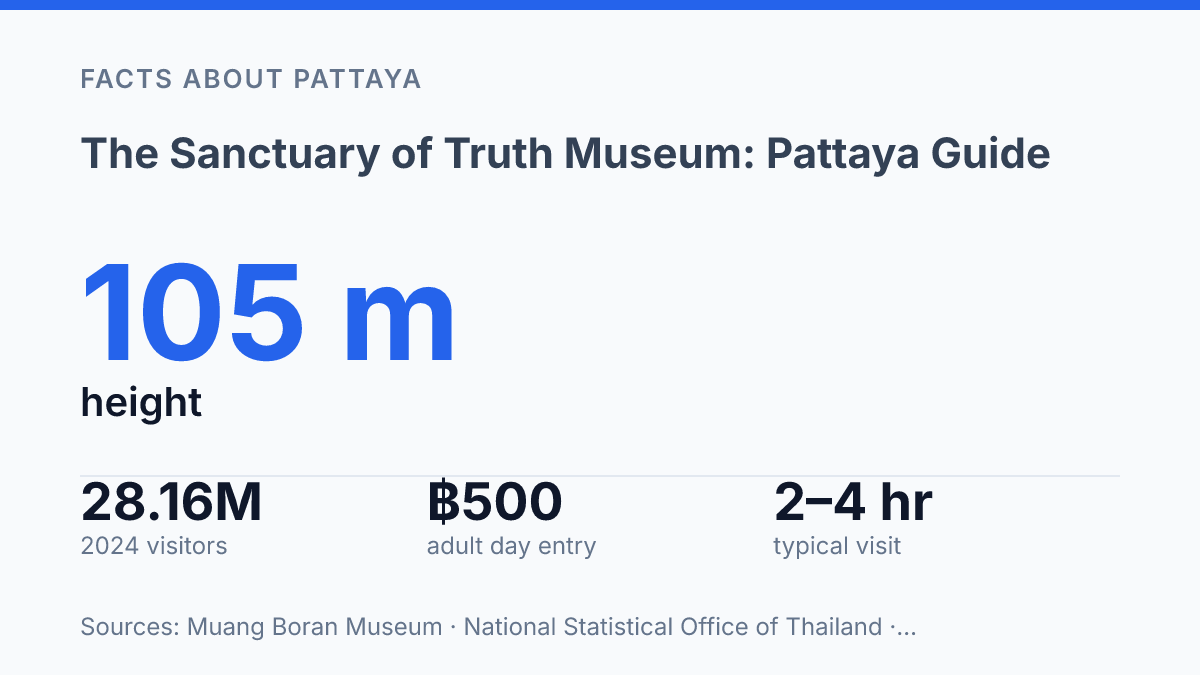
The Sanctuary of Truth Museum rises 105 metres above Pattaya as an all-wood structure that Thai government sources describe as built without metal nails, yet it remains deliberately unfinished. That combination makes it harder to classify than a standard museum, temple, or photo stop. Its carved surfaces draw on Thai, Khmer, Chinese, and Indian visual traditions, while the visitor route is organised around seven themes that move from human origins to family and society.
The practical side is unusually clear for a major attraction: adult day entry is ฿500, English tours run more than 15 times daily, and a typical visit is estimated at 2–4 hours. This guide examines how the monument’s symbolism, construction, access arrangements, and role in Pattaya’s tourism economy fit together.
What the unfinished wooden monument represents
A monument sold through timed tickets also asks visitors to think about origin, death, civilisation, family, and the purpose of life. That dual identity explains why the site is commonly described as an unfinished museum, yet often experienced less like a conventional gallery than a symbolic wooden sanctuary shaped around moral and cosmological ideas.
Designed by Thai businessman Lek Viriyaphan, the structure is presented as a hybrid of a temple and a castle rather than as a replica of a single historic building. Its theme draws on the Ayutthaya Kingdom, while its imagery blends Hindu and Buddhist beliefs into a single interpretive programme. The result is not simply decorative revivalism; the carvings and spatial sequence are meant to express ideas about human conduct, impermanence, social order, and spiritual aspiration.
The unfinished condition is central to its meaning. Instead of functioning only as a completed attraction, the monument remains a work in progress, with continuing craftsmanship reinforcing the idea that cultural inheritance is made, repaired, and reinterpreted over time. Official interpretive material frames the visitor route around seven “life truth” themes, including origin, death, civilisation, life’s goal, society’s two sides, and family as the starting point of society.
As of 2026, published admission also makes clear that the site operates within Pattaya’s organised visitor economy: adult day tour entry is ฿500 and adult night tour entry is ฿700, according to the Sanctuary of Truth Museum. This practical museum model sits beside religious and philosophical symbolism, which is why the attraction stands out among Pattaya’s leisure sites as both an architectural work and a cultural statement.
Architecture, carving, and design influences
Muang Boran Museum gives the monument’s height as 105 metres, a scale that makes its carved timber profile read less like a pavilion than a vertical landmark. Its plan is also substantial, measuring 100 metres from north to south and 100 metres from east to west, according to Muang Boran Museum in 2026. Those dimensions matter because the building’s visual force comes from the combination of mass and material: an enormous structure presented through layered wood surfaces, projecting roofs, spires, columns, and densely worked ornament.
The museum’s material identity is unusually strict. A Thai government page from 2026 describes the site as an all-wood, temple-like structure built without metal nails, which places joinery and timber maintenance at the centre of its architectural character.
The result is not only a wooden building with decoration added to it, but a structure whose surface, support, and symbolic imagery are all expressed through carving. Figures, floral patterns, mythic beings, and narrative panels create the hand-carved appearance that defines the visitor’s first impression and also explains why repair work and new carving remain visible parts of the site over time.
Stylistically, the building draws on Myanmar architecture and Hindu architecture rather than following a single historical model. Myanmar influence is most legible in the tiered roof forms, upward thrust, and ornamental density associated with timber religious buildings, while Hindu architectural influence appears in the use of mythological figures, cosmic guardians, and vertical emphasis. The temple-castle form helps organize these sources into a single silhouette: the castle-like mass gives the structure presence and enclosure, while the temple-like spires and carved program direct attention upward and outward.
This is why the monument invites comparison with sacred architecture, even though its continuing, unfinished condition changes how it is read. It is experienced not as a sealed historic relic, but as a large wooden work still being carved, conserved, and structurally managed in public view.
Location, access, and contact details
The site can be pinned to a full Thai postal address rather than a broad Pattaya label: 206, 2 Soi Na Kluea 12 Moo 5, Muang Pattaya, Bang Lamung District, Chon Buri 20150, Thailand. That placement identifies it within Muang Pattaya in Chon Buri province, with the district and postcode included for clearer mapping, booking records, and formal enquiries.
Why it matters in Pattaya’s visitor economy
Chon Buri recorded 28,156,302 visitors and ฿316,811.02 million in visitor receipts in 2024, according to the National Statistical Office of Thailand, placing Pattaya’s leading attractions inside one of Thailand’s largest tourism economies. In that context, the museum matters not only as another stop on an itinerary but as a recognisable Pattaya landmark with a clearer cultural identity than many leisure-led attractions in the city.
Its appeal comes from the combination of Thai craft, religious symbolism, and construction on a monumental scale. Visitors interested in carving traditions, sacred imagery, and the process of making a large cultural structure can read the site in more than one way: as a museum, as a visual landmark, and as a continuing craft project. That breadth helps explain why it draws attention beyond standard sightseeing, especially for travellers seeking cultural content without separating it from a highly photogenic setting.
The site is also set up to convert visual impact into interpretation rather than leaving visitors to view it only as a backdrop. The museum’s FAQ estimates a typical visit at 2–4 hours, including a guided-talk component of about 45–60 minutes, which indicates that explanation is built into the experience rather than treated as optional background. Scheduled English-language tours through the day and evening also show how the attraction is structured for international visitors, not only domestic cultural tourism.
This broad appeal gives the landmark a distinctive role in Pattaya, but it can also shape expectations in different directions. Some visitors may arrive primarily for the spectacle of a large sculptural structure, while others may be more engaged by the moral and religious themes embedded in the museum route.
The continuing construction adds another layer: it can make the visit feel dynamic and workshop-like, though it also means the site is not experienced as a conventional finished museum. That mix of spectacle, interpretation, and visible workmanship is central to its value within Pattaya’s visitor economy.
Why Pattaya’s Wooden Landmark Carries Economic Weight
A site of this scale affects Pattaya in two ways at once: it gives visitors a cultural anchor beyond beaches and nightlife, and it requires the operational discipline of a high-volume attraction. Published tour schedules, parking capacity, and timed interpretation help turn a complex philosophical monument into something that can function inside Chon Buri’s large visitor economy.
The harder question is how the museum will balance preservation, ongoing craftsmanship, and demand as regional travel keeps expanding. Its unfinished state may be the practical answer as much as the artistic one, because the place depends on continued carving, repair, explanation, and controlled access rather than a single completed reveal.
Frequently Asked Questions
Q: Where is the Sanctuary of Truth Museum located in Pattaya?
A: It is located at 206, 2 Soi Na Kluea 12 Moo 5, Muang Pattaya, Bang Lamung District, Chon Buri 20150, Thailand. The site is in the Na Kluea area of Pattaya, which makes it accessible from the city’s northern beachfront district.
Q: Who designed the Sanctuary of Truth Museum?
A: The museum was designed by Lek Viriyaphan, a Thai businessman known for commissioning large cultural and religious projects. His vision shaped the building into a symbolic structure rather than a conventional museum hall.
Q: Is the Sanctuary of Truth Museum finished?
A: No. The Sanctuary of Truth is an unfinished museum, and that status is part of its identity. Ongoing work means the site remains both a tourist attraction and a long-term construction project.
Q: What style of architecture is used in the Sanctuary of Truth?
A: The structure combines Myanmar architecture and Hindu architecture, while also taking the form of a hybrid temple and castle. Its design reflects themes from the Ayutthaya Kingdom as well as Hindu and Buddhist beliefs.
Q: What is the contact number for the Sanctuary of Truth Museum?
A: The contact number listed for the site is +66 81 350 8710. Calling ahead is the most direct way to confirm opening details, ticket arrangements, or visit requirements.