
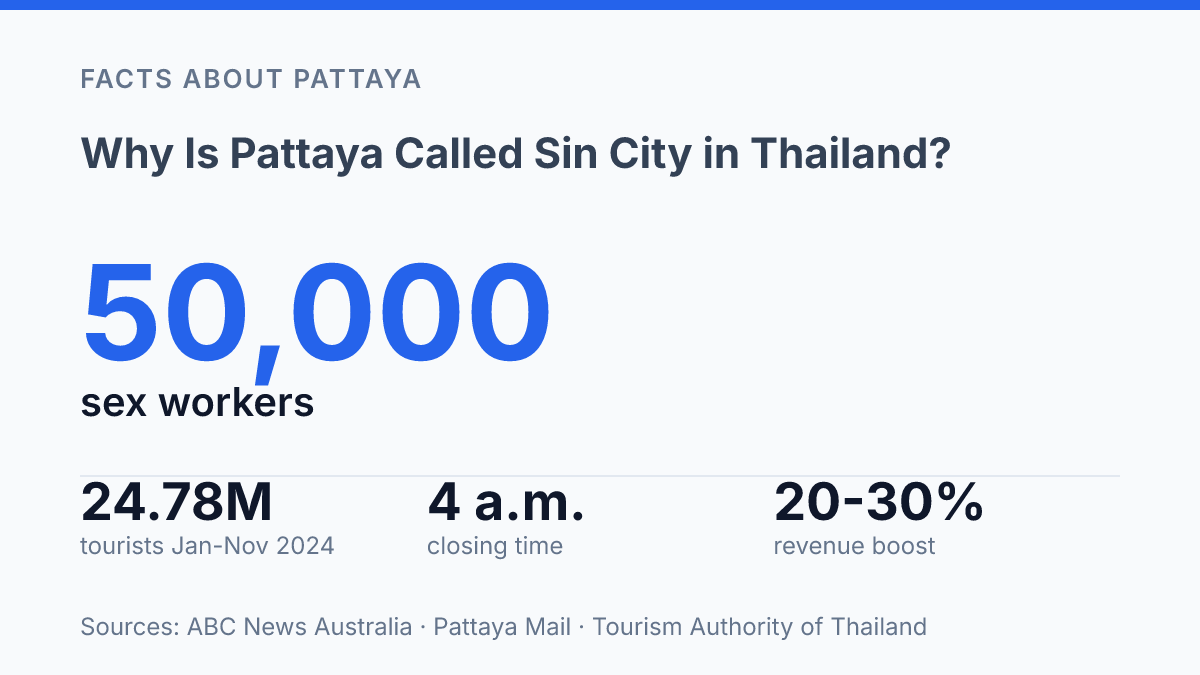
Why is Pattaya called Sin city in Thailand? The label traces back less to a single nightlife district than to a Vietnam War-era visitor economy that survived after U.S. forces left in 1976. At the peak, 40,000–50,000 American service personnel were stationed in Thailand, with Pattaya gaining from nearby Sattahip naval base and U-Tapao airfield.
The city’s later reputation was reinforced by a legal contradiction: prostitution was criminalised in 1960, yet entertainment laws from 1966 allowed bars and massage venues to operate in ways that kept commercial sex semi-visible. That history still shapes how Pattaya is interpreted, even as Chonburi recorded 24.78 million tourists in the first 11 months of 2024. The question is not whether the nickname is accurate in a simple sense, but why it remains persuasive when the city now also depends on families, domestic travellers, hotels, malls, and mass-market beach tourism.
How the label developed
Pattaya’s nickname has roots less in an official campaign than in infrastructure left behind after wartime military tourism. During the Vietnam War, 40,000–50,000 U.S. service personnel were stationed in Thailand at the peak; Pattaya benefited from the nearby Sattahip naval base and U-Tapao airfield, and U.S. forces withdrew in 1976 while Pattaya’s nightlife infrastructure remained, according to AP News. That history helps explain why the town’s later image was not created from nothing by modern party tourism, but grew from an existing pattern of entertainment businesses serving foreign visitors.
From the 1970s onward, Pattaya expanded from a modest coastal destination into one of Thailand’s best-known beach resort towns. Foreign tourism gave the city a larger hotel base, a stronger restaurant and bar economy, and a nightlife sector that became unusually visible because it was concentrated in specific streets and districts. Areas such as Walking Street, Soi 6, and Soi Buakhao became shorthand for adult entertainment, late-night bars, go-go venues, and beer-bar complexes, making the reputation easy for outsiders to recognise and repeat.
English-language media and travel writing then turned those visible nightlife zones into a recurring label. The phrase “sin city” worked as a compact description for guidebooks, newspaper features, online forums, and travel commentary because it captured the part of Pattaya that many foreign visitors already associated with the city. Repetition gave the term durability: it became common shorthand, not an official designation by the Thai government.
The weakness of the label is that it compresses a wider urban identity into one marketable stereotype. Pattaya’s nightlife districts are real and historically important to its tourism economy, but the phrase reduces a beach city with residents, domestic tourists, family attractions, hotels, shopping centres, and regional transport links to its most visible adult-entertainment image. That tension explains both why the nickname developed and why it has remained contested.
What fuels the reputation
Since 15 December 2023, selected entertainment venues in Chon Buri tourist areas, including Pattaya, have been allowed to trade until 4 a.m., formalising the late-night economy that visitors already associated with the city. The best-known showcase is Walking Street, where bar districts, go-go bars, live music venues, clubs and late-night restaurants concentrate adult-oriented entertainment in a relatively small and highly visible area. That concentration matters because reputation is shaped not only by what exists, but by how easy it is for visitors, media and online searchers to identify it.
Sex tourism remains a central reason Pattaya is perceived differently from many other Thai beach destinations. Phuket, Koh Samui and Krabi also have nightlife, but their international images are more strongly balanced by resort beaches, island excursions and family holiday marketing. Pattaya’s adult nightlife is more visible in core tourist areas, making it easier for the city to be discussed through that lens even when many arrivals come for ordinary leisure, events, shopping or short breaks.
Massage shops, beer bars and entertainment venues also help blur the line between mainstream tourism and adult-oriented nightlife. A beer bar can function as a casual drinking venue, a social meeting point and, in some cases, part of a wider sex-tourism economy.
AP News has described Thailand’s system as a legal grey zone in which prostitution is illegal, yet adult services may operate semi-openly through entertainment venues and massage parlours as private arrangements between workers and customers. This ambiguity is one reason the city’s nightlife is often interpreted differently from conventional bar or club districts elsewhere.
The economic incentives reinforce the pattern. Pattaya entertainment businesses told Pattaya Mail in 2024 that extended opening hours raised daily revenue by 20–30%, while service staff reported earning an extra 300–500 baht per day.
Enforcement reports keep the issue visible as well: Khaosod English reported that Tourist Police arrested 20 foreign nationals along Pattaya Beach on prostitution-related charges on 27 December 2024. These details help explain why the nickname persists, although the same evidence also shows a specific nightlife economy rather than a description of every district, business or visitor experience.
How Pattaya is seen beyond the nickname
A province drawing 24.78 million tourists in eleven months cannot be explained by adult entertainment alone. Chonburi welcomed that number from January–November 2024, up 17.92% year on year and generating 264.3 billion baht, according to Pattaya Mail. The scale matters because Pattaya is the province’s best-known tourism hub, and its visitor economy depends on far more than the activities that shaped the nickname.
For families and general holidaymakers, the city is also associated with beaches, gardens, viewpoints, religious architecture and short-stay resort facilities. Pattaya Beach remains the central urban waterfront, while Jomtien Beach is commonly positioned as a calmer coastal alternative. Nong Nooch Tropical Garden adds a landscaped day-trip attraction outside the beach zone, and the Sanctuary of Truth gives the city a major cultural landmark built around Thai craftsmanship and religious symbolism.
Domestic demand is a major part of that wider profile. Pattaya functions as a convenient weekend destination for Bangkok residents, which helps explain why the city is not only dependent on long-haul foreign visitors.
CBRE reported that in H2 2025, Chonburi received 13.8 million visitors, with Thai travellers making up 64% of arrivals; it also counted Pattaya’s hotel supply at 34,743 keys across 161 properties. Those figures point to a mature accommodation market serving leisure trips, meetings, repeat domestic travel and short breaks.
Local authorities and tourism businesses have tried to build on this broader base by promoting events, sports tourism and conventions alongside beach holidays and family attractions. This does not erase the visibility of the adult entertainment industry, which remains easier for many outsiders to recognise than less sensational parts of the economy. It does, however, make the city’s public image more layered: Pattaya can be a family beach break, a domestic weekend stop, a meetings destination and a place with a persistent adult-entertainment reputation at the same time.
Why the nickname still sticks
A two-word nickname survives online because it solves a search problem: it tells algorithms and travellers which version of Pattaya is being discussed before any detail appears. Search results, forum threads, video titles, and travel-advice pages continue to use Sin City as a compact label because it is recognizable, easy to repeat, and strongly associated with questions about safety, nightlife, scams, accommodation choices, and local etiquette. That repetition matters: once a phrase becomes the common wording for a destination’s most debated image, new content tends to reuse it because readers are already searching for it.
The same shorthand also compresses a complicated place into a single expectation. In practical terms, the phrase often signals that a source is discussing adult entertainment, late-night behaviour, or the city’s reputation among foreign visitors rather than giving a balanced account of daily life.
This makes the label useful as a warning sign or search category, but weak as a general description. It can identify one highly visible identity of the city while excluding other patterns of travel, residence, work, and domestic leisure.
A clear gap often appears between the reputation and the experience of visitors who stay away from the most nightlife-focused areas. In residential neighbourhoods, condo zones, and resort-heavy parts of the city, the everyday impression may be shaped more by traffic, beach access, cafés, shopping centres, hotel facilities, and long-stay foreign residents than by the image implied by the nickname.
The contrast does not make the reputation false; it shows that the label is geographically and socially uneven. Pattaya can feel very different depending on accommodation choice, time of day, travel purpose, and proximity to entertainment clusters.
For that reason, the nickname is best read as descriptive rather than complete or neutral. It points to a real and persistent strand of Pattaya’s public identity, but it does not function like an official classification, a full travel assessment, or a fair summary of the whole city. The phrase still sticks because it is memorable and searchable, even though it oversimplifies a destination with several tourism identities operating at the same time.
Why the old label depends on what happens after midnight
Nicknames survive when they compress a complicated place into an image that is easy to repeat. Pattaya’s challenge is that parts of the image remain observable, from late-night entertainment policy to periodic prostitution-related arrests, while the city’s economic base is moving in a broader direction. If future policy separates licensed nightlife, labour protection, child protection, and conventional tourism more clearly, the label may lose some of its explanatory power.
If those issues remain blurred, new hotel stock and rising domestic arrivals will not erase the old association. The practical consequence is clear: Pattaya’s reputation will change less through slogans than through what visitors, residents, police, and workers see after midnight.
Frequently Asked Questions
Q: Why is Pattaya often called Sin City in Thailand?
A: The label comes from Pattaya’s long-standing reputation for nightlife, adult entertainment, and easy access to bars and clubs. The nickname is informal and reflects a narrow part of the city’s economy rather than the full range of activities there.
Q: Is Pattaya really more seedy than other Thai beach destinations?
A: Pattaya is often perceived as more nightlife-focused than many other coastal cities, which helps explain the nickname. That perception is shaped by tourism patterns, not by any official designation, and it does not describe every part of the city.
Q: What kind of nightlife is Pattaya known for?
A: Pattaya is known for bars, nightclubs, live music venues, and entertainment districts that cater to late-night visitors. This concentration of venues has made it one of Thailand’s best-known party destinations.
Q: Has Pattaya’s image changed in recent years?
A: The city has broadened its appeal with family attractions, beach activities, and more mainstream tourism options. Even so, its older reputation remains visible because nightlife continues to be a major part of its brand.
Q: Is it safe to visit Pattaya despite its reputation?
A: Pattaya is a major tourist city, and many visitors experience it without serious issues. As in any busy resort area, standard precautions around nightlife, transport, and valuables are sensible.